
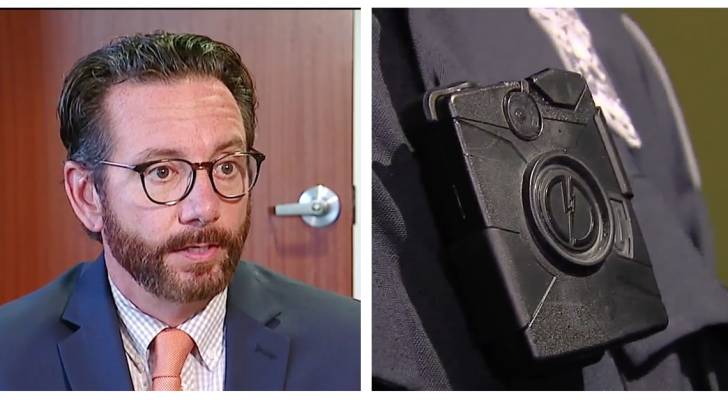
A Detroit police officer has been suspended without pay after he was allegedly caught stealing $600 from a suspect’s purse. While he hasn’t been charged yet, the evidence is strong — it comes from his own body camera.
“Our (internal affairs) lieutenant took a look at the video and immediately recognized that we had a criminal act here,” Commander Michael McGinnis told WXYZ Detroit.
Must Read
- Thanks to Jeff Bezos, you can now become a landlord for as little as $100 — and no, you don’t have to deal with tenants or fix freezers. Here’s how
- I’m 49 years old and have nothing saved for retirement — what should I do? Don’t panic. Here are 6 of the easiest ways you can catch up (and fast)
- Dave Ramsey warns nearly 50% of Americans are making 1 big Social Security mistake — here’s what it is and 3 simple steps to fix it ASAP
The officer is a four-year veteran of the Detroit Police Department. Here’s what happened, and why it matters beyond one traffic stop.
What happened
On March 7, three officers — including the accused — pulled over a car involved in a suspected drug deal. After a search, they found illegal drugs and arrested the driver and passenger.
When the suspects were later released, the woman in the passenger seat reported that about $600 was missing from her purse. She filed a complaint with the Office of the Chief Investigator.
The theft was “obvious” on the accused’s body camera, McGinnis told WXYZ Detroit. An envelope of cash disappeared from the woman’s purse while the camera was recording. There’s no evidence the other two officers were involved or even aware of what happened.
While police can seize possessions connected to illegal activity — a practice known as civil asset forfeiture — in this case, the missing money wasn’t mentioned in the police report, listed in inventory or placed into evidence.
The department is now reviewing the officer’s other body camera footage to see if similar incidents have occurred.
Commissioner Ricardo Moore, who oversees the department, told WXYZ Detroit that officers often fail to turn on their body cameras or shut them off during stops.
“I’m just happy that the body-worn camera situation worked,” Moore said. “I’ve been lobbying because a lot of officers turn off the body-worn cameras.”
Read more: Robert Kiyosaki warns of a ‘Greater Depression’ coming to the US — with millions of Americans going poor. But he says these 2 ‘easy-money’ assets will bring in ‘great wealth’. How to get in now
The financial toll of police misconduct
Police misconduct doesn’t just erode public trust — it also comes at a cost to taxpayers.
When lawsuits are filed against officers for misconduct, cities or counties typically provide legal representation. Whether a case settles or goes to trial, it’s the government, not the officer, that usually foots the bill.
“Every year, taxpayers in cities and counties across the country pay hundreds of millions of dollars to settle lawsuits filed in response to police misconduct, lawsuits that are often settled in secret by municipalities to quietly bury criticism and controversy,” Rep. Don Beyer and Sen. Tim Kaine wrote in a 2021 op-ed for CNBC.
At that time, Beyer and Kaine had introduced the Cost of Police Misconduct Act, which would have required law enforcement agencies to report annual spending on misconduct judgments and settlements to the Department of Justice. The bill, however, did not become law.
According to their op-ed, taxpayers cover these costs through premiums on municipal liability insurance or, in many larger cities, through general or dedicated funds.
“The money taxpayers spend on police misconduct has the potential to defund other municipal services, including those proven to prevent crime,” Beyer and Kaine wrote.
In other words, millions of dollars in judgments and settlements can divert funds from education, infrastructure and other public priorities.
A 2022 investigation by The Washington Post found that the 25 largest police departments in the U.S. had spent $3.2 billion on settlements over the past decade. In 2024 alone, Chicago taxpayers paid $107.5 million in misconduct lawsuits, while New York City paid more than $205 million, according to Window to the World (WTTW).
Police misconduct also carries a wider cost when it damages community relations or leads to civil unrest.
In 2020, after the death of George Floyd, protests in 140 cities were mostly peaceful, but some incidents of arson, vandalism and looting led to insured property losses estimated at $1 billion to $2 billion, according to Axios.
And sometimes, all it takes is one incident to tarnish the reputation of an entire department.
“I wouldn’t be doing my job if I wasn’t worried,” McGinnis said. “What worries me is that this is an officer wearing a police uniform stealing from the citizens.
“I see it as just him doing it, but the rest of the world sees it as Detroit police stealing. And that’s just not the case.”
What to read next
- The ‘Oracle of Wall Street’ who predicted 2008 crash sees trouble in US housing — and says boomers aren’t as rich as many think. Why that’s a problem
- There’s still a 35% chance of a recession hitting the American economy this year — protect your retirement savings with these 5 essential money moves ASAP
- This tiny hot Costco item has skyrocketed 74% in price in under 2 years — but now the retail giant is restricting purchase. Here’s how to buy the coveted asset in bulk
- Want an extra $1,300,000 when you retire? Dave Ramsey says this 7-step plan ‘works every single time’ to kill debt, get rich in America — and that ‘anyone’ can do it
Join 200,000+ readers and get Moneywise’s best stories and exclusive interviews first — clear insights curated and delivered weekly. Subscribe now.
This article provides information only and should not be construed as advice. It is provided without warranty of any kind.
Related Posts