
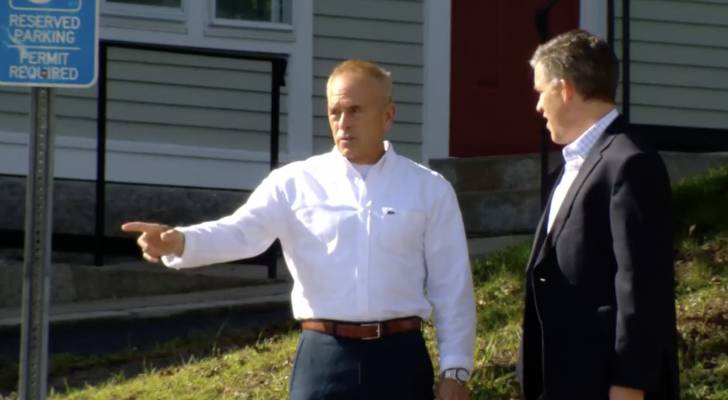
In East Greenwich, Rhode Island — a town known for its close-knit community and lively downtown — homeowner Andy Gough has had enough of his neighbor. The problem is his neighbor is the Town Hall.
Gough says the town has been taking advantage of him by parking both official and personal vehicles on the paved area in front of his home, land he owns.
Must Read
- Real Estate: Thanks to Jeff Bezos, you can now become a landlord for as little as $100 — and no, you don’t have to deal with tenants or fix freezers. Here’s how
- Retirement: Dave Ramsey warns nearly 50% of Americans are making 1 big Social Security mistake — here’s what it is and 3 simple steps to fix it ASAP
- Investing: Warren Buffett used 8 solid, repeatable money rules to turn $9,800 into a $150B fortune. Start using them today to get rich (and stay rich)
“I have to put extra insurance on it. And I pay taxes on it. And the town uses it for free,” Gough told NBC10 about the parking area on Peirce Street. (1)
For decades, there was an informal understanding that allowed the town to use the space, dating back to the property’s previous owner. But after a decade of ownership, and facing rising insurance and tax bills, Gough says he’s reached his tipping point.
These informal “gentlemen’s agreements” once worked fine in small towns, but rising insurance and property costs have made them harder to justify. Homeowners today are more cautious about who uses their land, and who’s liable when something goes wrong.
Frustrations rising
On September 8, Gough emailed the town manager to say he was no longer comfortable with people using his property as a parking lot. In the message, he even suggested it might be time to start billing the town.
“I don’t even know how long this goes back, but I’m thinking it should be around $7,000,” he wrote.
When he didn’t receive a response, Gough reached out to NBC10’s investigative team, saying the silence from town officials worried him, especially since he’s the one carrying the liability for what happens on his property.
In Rhode Island, that liability doesn’t come cheap. The median annual property tax bill in the state is about $4,920, according to Ownwell. (2) Property taxes also make up roughly 22% of combined state and local revenue, one of the highest reliance rates in the U.S., data from the Lincoln Institute of Land Policy shows. (3)
High taxes aren’t the only thing weighing on Rhode Island homeowners. Liability insurance has become just as important as the state continues to see more claims tied to personal injury and property damage. (4) Without the right coverage, a simple accident on your property could spiral into a costly lawsuit — and an even bigger headache.
Read More: No time to lower your crippling car insurance rate? Here’s how to do it within minutes — you could end up paying $29/month without a single phone call
The town’s side
After Gough’s email went unanswered, NBC10 reached out to Town Manager Andrew Nota and got a reply within the hour.
Nota said he had just returned from several weeks out of the office but confirmed he had received Gough’s original message. He added that he has since instructed town staff to stop parking on Gough’s property, noting that the homeowner is within his rights to change how the land is used.
Still, Nota emphasized that the informal parking arrangement wasn’t new — in fact, it’s been part of daily life at Town Hall for roughly three decades. He suggested that an abrupt end to the long-standing practice might catch many off guard.
"I believe Mr. Gough is seeking to immediately prohibit future use, which on the surface, from my review appears to be within his rights, although might not be the way that I would handle the situation,” Nota wrote, adding that he intends to give staff time to adjust before enforcing the change.
"I’m curious as to how any resident would react if the Town treated them in a similar manner under the same circumstances, with an immediate notice to vacate after a 30-year agreement?"
One exception remains: A neighboring church holds a legal easement that allows its congregation to park on Gough’s property during services, an arrangement that will stay in place.
For everyone else, the days of treating Gough’s lot for free parking may soon be over.
What to read next
- Dave Ramsey says this 7-step plan ‘works every single time’ to kill debt, get rich — and ‘anyone’ can do it
- Robert Kiyosaki says this 1 asset will surge 400% in a year — and he begs investors not to miss its ‘explosion’
- Even in a choppy market, young millionaires are betting big on these asset classes — and older Americans should take note
- I’m almost 50 years old and have nothing saved for retirement. What do I do? Don’t panic. Here are 6 easy ways to catch up (and fast)
Join 200,000+ readers and get Moneywise’s best stories and exclusive interviews first — clear insights curated and delivered weekly. Subscribe now.
Article sources
We rely only on vetted sources and credible third-party reporting. For details, see our editorial ethics and guidelines.
NBC 10 (1); Ownwell (2); Lincoln Institute of Land Policy (3); Brook Insurance Associates (4).
This article provides information only and should not be construed as advice. It is provided without warranty of any kind.