
San Juan, Puerto Rico, June 26th, 2026, NewsDirect
— NIST report finds Champlain Towers South began failing weeks before collapse —
— Estructura says continuous satellite and on-premise AI monitoring would have detected the warning signs in time —
Five years to the day after the catastrophic collapse of Champlain Towers South in Surfside, Florida claimed 98 lives, federal investigators have confirmed what many in the structural engineering and building safety community long suspected: the building did not fail without warning. It failed slowly, visibly, and measurably, over a period of weeks, while no system existed to read those signals.
The National Institute of Standards and Technology (NIST) released its final investigative report on June 23, 2026, finding that two connections between garage columns and the pool deck began failing in early June 2021, nearly three weeks before the building gave way at 1:22 a.m. on June 24. Investigators documented visible cracking in planter walls, accelerating water infiltration in the parking garage, and a pool-deck section that had fully detached from the slab in the hours before the collapse.
The building’s structural inadequacy, NIST found, was present from construction: in some locations, the design provided less than half of the required code-level strength.
Forty years of salt-air corrosion, water intrusion, and deferred maintenance compounded those original deficiencies until the structure had no margin left.
What continuous monitoring would have seen
Estructura, a structural intelligence company headquartered in San Juan, Puerto Rico, with offices in Miami and Lima, says the Surfside tragedy illustrates precisely why continuous, AI-powered structural monitoring is no longer a luxury; it is a life-safety necessity.
The company deploys what it describes as the only vertically integrated combination of its kind: GeoSIG precision ground sensors paired with the GeoSMART AI-based software platform, and TerraIntel satellite InSAR (Interferometric Synthetic Aperture Radar) imaging that detects millimeter-scale ground deformation and subsidence invisible to on-site inspection.
Applied to Champlain Towers South, that combination would have produced a cascade of alerts weeks before the collapse. TerraIntel’s satellite imaging would have tracked differential subsidence of the pool deck slab as reinforcing steel corroded and structural connections weakened beneath it, changes detectable at the millimeter level from orbit. GeoSIG’s on-premise sensor network would have registered anomalous micro-vibrations, deflection patterns, and load redistribution across the garage columns, precisely the structural behavior NIST now confirms was occurring in the weeks prior to collapse. GeoSMART’s AI trend analysis would have flagged both data streams as anomalous and triggered automated early-warning alerts.
The result: building managers, engineers and residents would have had days or weeks to act.
Surfside was one scenario. Buildings Face Four
Estructura emphasizes that the structural design failures documented at Champlain Towers South — original code deficiencies, material deterioration, and decades of deferred maintenance — represent only one of four categories of risk that can push any building toward catastrophic failure:
- Design flaws and construction deficiencies. As Surfside demonstrated, a structure can be vulnerable from day one. Substandard design, code non-compliance, and construction that diverges from engineered drawings create hidden fault lines that only manifest — catastrophically — decades later.
- Wear, aging, and deferred maintenance. Even well-built structures degrade. Corrosion, water intrusion, carbonation of concrete, and decades of load cycling steadily erode safety margins. The combination of original deficiency and aging maintenance is what NIST identifies as the final mechanism at Surfside.
- Seismic events. In earthquake-prone regions across the Americas — from Puerto Rico and the Caribbean to the Pacific coasts of Mexico, Colombia, Peru, and Chile — buildings face repeated ground-motion stress that accumulates damage invisibly between events. A structure that survives a 6.0 magnitude earthquake may be weakened for the next one.
- Extreme climate events. Hurricanes, floods, tornadoes, wildfires, and sustained heat waves are intensifying in frequency and severity. Each event imposes structural loads and environmental stresses that can compromise a building’s long-term integrity, often in ways that standard post-event visual inspections miss entirely.
Estructura’s monitoring platform is designed to detect the structural signatures of all four risk categories, before small deviations become irreversible failures.
The technology: An EKG for any structure
Estructura was founded as a division of Dorado Services, a U.S. engineering firm and federal contractor to the Army Corps of Engineers and FEMA since 1999. That heritage — grounded in emergency response, disaster management, and hands-on structural assessment — is what the company says distinguishes it from pure-technology vendors.
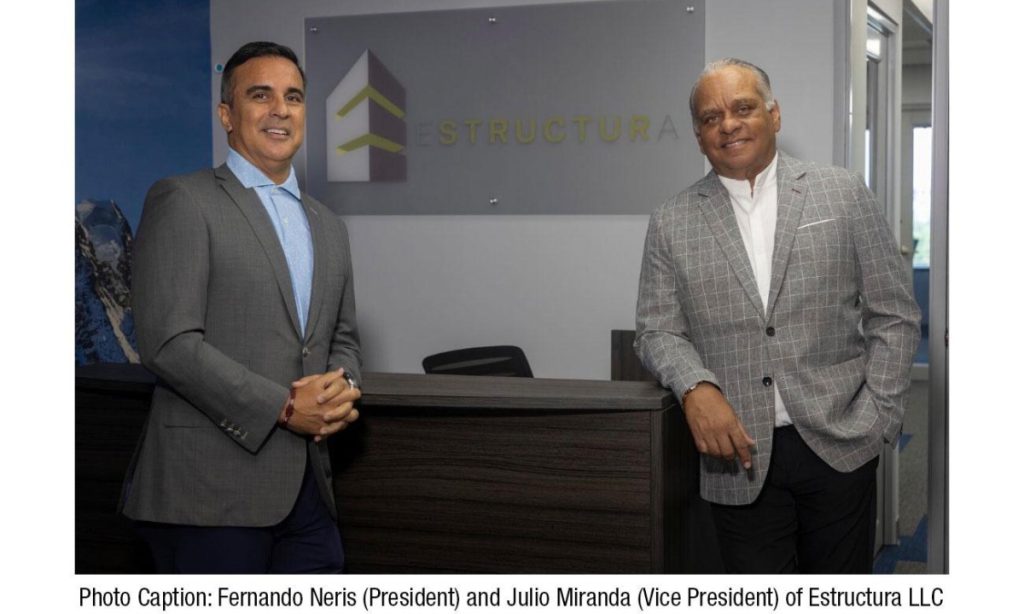
“We understand what happens when structures fail,” said a Julio Miranda, Estructura Vice President and co-founder. “We’ve built our company around preventing it.”
The company integrates two world-class technologies into a single monitoring solution:
- GeoSIG + GeoSMART: The Swiss-based global leader in structural and seismic monitoring for over 30 years, GeoSIG provides precision on-premise sensors and the GeoSMART software platform, a real-time “Black Box” for any structure, powered by AI-based trend analysis and anomaly detection.
- TerraIntel Satellite InSAR: Satellite-based intelligence that tracks ground deformation, subsidence, and environmental risks at scales invisible to ground-level sensors, providing a second, independent layer of structural intelligence.
The combined system is deployable in any structure type — high-rises, apartment complexes, bridges, hospitals, stadiums, airports, dams, and critical public infrastructure — anywhere on the planet. Estructura’s geographic focus is the Americas, served from offices in San Juan, Miami, and Lima, with full bilingual English-Spanish capability.
The company reports that clients typically recover their full monitoring investment within one to two years through the combined benefits of predictive maintenance savings, disaster mitigation, reduced insurance premiums, and enhanced property value.
A Lesson That Must Not Be Lost
The NIST findings arrive five years after the Surfside collapse prompted Florida to pass landmark legislation requiring condominium associations to maintain adequate reserves for major structural repairs. But Estructura notes that regulation alone is insufficient without the means to continuously verify structural condition.
“A reserve fund is only useful if you know what you need to repair, and when,” Miranda added. “The Surfside building gave weeks of warning that no one had the technology to read. Every building owner and manager in a coastal city, a seismic zone, or a hurricane corridor should ask themselves the same question: if my building were failing right now, would I know?”
Estructura’s mission — to make structures safer, smarter, and more resilient through AI-powered monitoring technology — is grounded in exactly that question. Its vision: a built world where every structure is intelligent, protected, and resilient.
To learn more about Estructura’s structural intelligence platform, visit estructura.tech.
About Estructura
Estructura deploys intelligent technologies that give structures a voice, and the people responsible for them the data to act. Founded as a division of Dorado Services — a U.S. engineering firm and federal contractor to the Army Corps of Engineers and FEMA since 1999 — Estructura integrates GeoSIG precision sensors, the GeoSMART AI monitoring platform, and TerraIntel satellite InSAR imaging into the only vertically integrated structural monitoring solution of its kind. The company serves the Americas from offices in San Juan, Miami, and Lima. estructure.tech
Contact
Yolanda Torres Cuesta
ARCO Relations
[email protected]
787-525-3652