
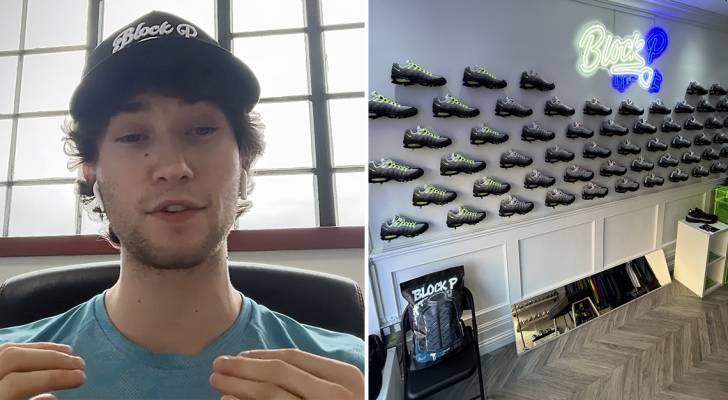
When you step into Block P, a sneaker shop tucked into the heart of Liverpool, the walls aren’t cluttered with endless silhouettes or the latest drops of sneakers. Instead, there is an almost reverent singularity: row after row of Nike Air Max 95s, each pair displayed like a chapter in a story the city has been telling for decades.
It’s a bold retail choice in an industry built on novelty, but for co-owner Sam Byrne, 25, focus isn’t a limitation; it’s a strategy. Designed by Sergio Lozano in 1995 and inspired by the human body’s layered anatomy, the Air Max 95 has long held a special place in Liverpool’s cultural DNA. Known locally as “110s,” the shoe became synonymous with the city’s street style in the late 1990s and early 2000s, a time when the original £110 price tag made it a status symbol (1).
Must Read
- Thanks to Jeff Bezos, you can now become a landlord for as little as $100 — and no, you don’t have to deal with tenants or fix freezers. Here’s how
- Robert Kiyosaki says this 1 asset will surge 400% in a year — and he begs investors not to miss its ‘explosion’
- Dave Ramsey warns nearly 50% of Americans are making 1 big Social Security mistake — here’s what it is and 3 simple steps to fix it ASAP
“The business that just sells one shoe shouldn’t really survive,” he told Moneywise. “But it works in Liverpool and that’s kind of because of the community and the culture that it’s built.”
That confidence is the same mindset that pushed him to try something few 25-year-olds would even consider: applying to be Nike’s next CEO.
Overcoming challenges
Early in our conversation, Byrne spoke about surviving odds most people never face.
He was born at 26 weeks and was one of six infants in his premature ward to survive. Resilience wasn’t something he learned later. It was baked into his origin story.
That instinct carried him through another crisis years later when a football accident left him with a fractured skull and unable to work. While he recovered, he shifted his energy toward trading and investing. It helped him stay afloat during the pandemic.
But Byrne’s relationship with risk evolved. Before Block P ever entered the picture, he lost $100,000 in a single day of trading, a financial blow that could have ended his investing journey. Instead, it reset his approach.
He abandoned the idea of timing markets or chasing the next hot stock. His strategy became discipline. Research backs that up. Vanguard found that lump-sum investing outperformed dollar-cost averaging between 61.6% and 73.7% of the time across global markets over rolling one-year periods from 1976 to 2022 (2).
“Every month I just put money into that because in the UK you can put £20,000 a year into that and when you take it out it’s tax free,” he said. “Rather than trying to buy or find the needle in the haystack I just buy the haystack and hopefully it’ll just average over time.”
Trending: Approaching retirement with no savings? Don’t panic, you’re not alone. Here are 6 easy ways you can catch up (and fast)
Betting on the culture
Byrne found an opportunity in August 2022, when he came across Block P and spoke to the owner at the time, Charlie McDonough. His plan was simple. He wanted to learn. In fact, he thought the learning would be more valuable than taking a wage for an entire year.
“I said to him, I’m going to work here for a year for nothing. I don’t want anything. I just want to be here. I want to learn from you. I want to learn about the industry. I think we can build something, something great long term,” he said.
The global secondary sneaker-resale market was estimated at US$10.6 billion in 2022 and is projected to reach US$51.2 billion by 2032 (3).
But for Byrne, the opportunity wasn’t just a lucrative business venture. It was cultural.
And his instincts align with broader retail trends. Specialty stores now account for nearly a quarter of all U.S. retail sales, a sign that consumers increasingly prioritize niche expertise and curated product lines over big-box variety. People don’t just want more options (4). They want meaningful ones, delivered by someone who genuinely knows the story behind the product.
That’s exactly what Block P offers.
The moment that crystallized this for Byrne came last Christmas. A father walked in searching for a rare pair of Air Max 95s for his son’s birthday. Byrne found them, but what stuck with him wasn’t the sale. It was the man’s story.
The customer explained that he had recently lost his father, the same man who first put him in a pair of 95s back in 1995. He showed Byrne a photo of himself and his dad in the original Neon 95s on a fishing trip. Then he pulled up a second photo. It was him and his son, decades later, wearing the same shoes. One sneaker carrying three generations.
That, Byrne says, is the point.
“He’s lived his whole life through this shoe,” Byrne explained. “He met his wife in the shoes, his child was born on the day that his shoe came out, you know, his dad passed that legacy onto him. And that’s something you can’t really put a price on, and that speaks to the impact of community.”
CEO of Nike
Byrne and his colleagues had built Block P into a business they were proud of. But Byrne wasn’t finished. At 25, he applied to be the CEO of Nike.
He wrote the company a confident, thoughtful email outlining exactly how he believed he could impact the brand. While many assumed Nike might ignore it entirely, they responded and invited him to their World Headquarters in Oregon for a six-month internship with their Brand Strategy and Marketing team.
For Byrne, the application was never just about a job title. It was an experiment in possibility, a reminder that you don’t need privilege or pedigree to dream big. He was, as he puts it, just a kid from Liverpool who took his shot without fear of rejection. And because he did, doors opened that he never expected.
“If it gives people confidence and the ability to go and apply for a job themselves or have a difficult conversation with someone or become better in themselves in any way, that’s what it was all about,” Byrne told Moneywise.
Toward the end of the hour-long interview, Byrne said what his goals would be for Block P in the next five years. Reaching a million orders would be nice, he said, but the real goal is to stay focused on how many lives the business has been able to how much change they can bring to their community.
Byrne added he was lacing up for a half marathon the next morning to raise money for men’s mental health and suicide prevention.
He’d be doing it in a pair of 110 slippers.
“We would be nothing without our community,” he said.
What to read next
- Here’s why wealthy investors are pouring millions into this 1 US asset class — and how to quickly copy the move while there’s still time
- Warren Buffett used 8 solid, repeatable money rules to turn $9,800 into a $150B fortune. Start using them today to get rich (and stay rich)
- Dave Ramsey says this 7-step plan ‘works every single time’ to kill debt, get rich — and ‘anyone’ can do it
- 22 US states are already in a recession — protect your savings with these 10 essential money moves ASAP
Join 200,000+ readers and get Moneywise’s best stories and exclusive interviews first — clear insights curated and delivered weekly. Subscribe now.
Article sources
We rely only on vetted sources and credible third-party reporting. For details, see our editorial ethics and guidelines.
Block P (1); Vanguard (2); Market Decipher (3); Amra and Elma (4).
This article provides information only and should not be construed as advice. It is provided without warranty of any kind.