
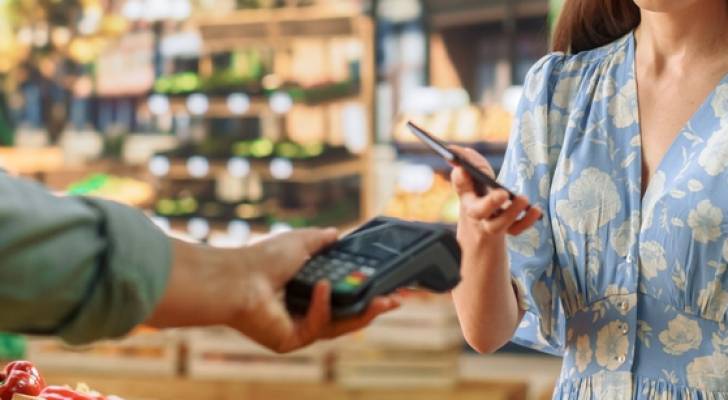
As contactless payments become an integral part of everyday life, a troubling scam dubbed “ghost tapping” is becoming known for exploiting the very convenience it promises.
Ghost tapping is a fraud method that targets the “tap-to-pay” feature found on cards and mobile wallets. It involves using near-field communication (NFC) technology, which enables a card or phone to exchange data with a payment terminal at very close range.
Better Business Bureau (BBB), a non-profit organization that helps consumers find out if a business is trustworthy, recently warned about this kind of fraud saying it had received several reports of it [1].
Must Read
- Real Estate: Thanks to Jeff Bezos, you can now become a landlord for as little as $100 — and no, you don’t have to deal with tenants or fix freezers. Here’s how
- Retirement: Dave Ramsey warns nearly 50% of Americans are making 1 big Social Security mistake — here’s what it is and 3 simple steps to fix it ASAP
- Investing: Warren Buffett used 8 solid, repeatable money rules to turn $9,800 into a $150B fortune. Start using them today to get rich (and stay rich)
One person reported their experience to BBB Scam Tracker: “An individual is going door to door in [location redacted] claiming to be selling chocolate on behalf of [redacted] to support special needs students. He says that he can only accept tap-to-pay to get people to pay with a card. He then charges large amounts to the card without the cardholder being able to see the amount. He got my mother for $537… Another victim for $1100 … He changes neighborhoods frequently to avoid getting caught.”
How does ghost tapping happen?
Unlike older scams that required a physical swipe or a tampered reader, ghost tapping can proceed without a card ever leaving its owner’s wallet or phone.
Scammers have several approaches:
-
They may bump or brush past someone in a crowded location with a hidden reader, triggering a payment from the victim’s tap-enabled device.
-
They might pose as vendors, charity collectors, or door-to-door sellers and insist on tap payments — then charge far more than the buyer expects.
-
In more sophisticated schemes, scammers trick victims into entering card details into phishing apps or links, add them to mobile wallets they control, and then make unauthorized tap-to-pay purchases — even without the physical card present.
In Missouri, local station KY3 News reported on a case of a scammer walking around with a “tap machine” and approaching people to read their cards through their purse or wallet. One person claimed to lose $100 [2].
Read More: No time to lower your crippling car insurance rate? Here’s how to do it within minutes — you could end up paying $29/month without a single phone call
The rising risk due to contactless payments
In 2023, the U.S. had approximately 17.9 billion contactless transactions and about 300 million contactless-enabled cards in circulation, according to Clearly Payments [3]. Fraudsters manipulate the contactless payment features that consumers favor to get information.
“Once a scammer has your credit card details and successfully adds them to their device’s wallet, they can make tap-based purchases in physical stores — no physical card, PIN, or ID required,” said Ian Bednowitz, the General Manager of LifeLock.
Because there is no requirement for a physical card or PIN in many cases, ghost tapping can be swift, discreet and hard to detect. Fraudsters frequently charge small amounts initially to avoid triggering bank alerts, then escalate later. The scam is especially dangerous at crowded events, such as festivals, transit stations, and busy markets, where a bump or distraction can facilitate the attack.
“It’s a digital scam with real-world consequences. Victims may never lose their card or even know it’s been compromised until charges appear on their statement. And because the fraud uses legitimate mobile wallet infrastructure, it can be harder for banks and consumers to distinguish between authorized and fraudulent activity,” warned Bednowitz.
The U.S. currently has limited constraints on contactless payment amounts compared with some other countries, making tap-to-pay broadly accessible and thus more vulnerable.
What should consumers do now?
Consumers should remain vigilant for subtle red flags that may indicate ghost tapping.
A good tip is to stay vigilant against any vendor who insists you “just tap” without displaying the complete total or offering receipts. Another warning sign is spotting small or odd “test” charges on your account after being in crowded venues.
Here are more tips:
-
Use an RFID-blocking wallet or card sleeve: RFID-blocking wallets can help prevent scammers from wirelessly accessing payment data through Near Field Communication (NFC) technology.
-
Always verify merchant details before tapping: Check the merchant name and amount on the payment terminal before tapping, especially in flea markets or festivals where fake vendor stands may be set up.
-
Enable real-time transaction alerts: Banks recommend setting up instant push notifications for all card activity.
-
Regularly review your statements: Check your transaction history regularly for small, unfamiliar charges that may indicate testing of stolen card credentials.
-
Report and act fast if you’re a victim: The Federal Trade Commission advises contacting your bank immediately to freeze the compromised card and filing a report at ReportFraud.ftc.gov.
As tap-to-pay becomes more common, it’s best to stay alert and verify every transaction. Don’t let the speed of contactless payments become your downfall.
What to read next
- Dave Ramsey says this 7-step plan ‘works every single time’ to kill debt, get rich — and ‘anyone’ can do it
- Robert Kiyosaki says this 1 asset will surge 400% in a year — and he begs investors not to miss its ‘explosion’
- Even in a choppy market, young millionaires are betting big on these asset classes — and older Americans should take note
- I’m almost 50 years old and have nothing saved for retirement. What do I do? Don’t panic. Here are 6 easy ways to catch up (and fast)
Join 200,000+ readers and get Moneywise’s best stories and exclusive interviews first — clear insights curated and delivered weekly. Subscribe now.
Article sources
We rely only on vetted sources and credible third-party reporting. For details, see our editorial ethics and guidelines.
Better Business Bureau (1); KY3 News (2); Clearly Payments (3)
This article provides information only and should not be construed as advice. It is provided without warranty of any kind.