
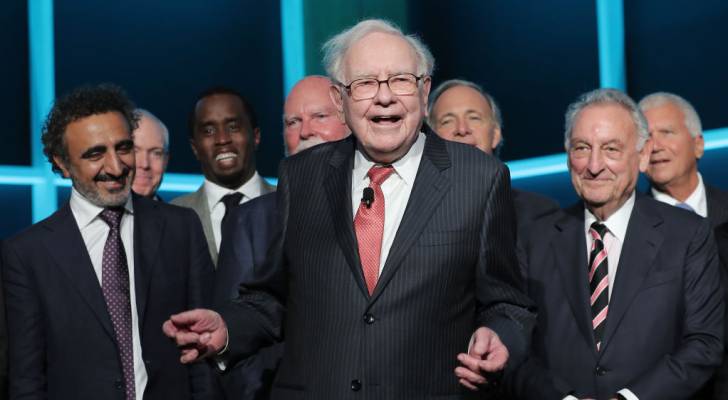
In a Thanksgiving letter to Berkshire Hathaway shareholders — his last before he steps down as CEO at the end of this year — legendary investor Warren Buffett notes that he bought his “first and only home” in his hometown of Omaha, Neb. in 1958 (1).
Today, Buffett is one of the richest people in the world, with a current net worth of about $154 billion, according to Forbes’ World Billionaires List (2).
Must Read
- Real Estate: Thanks to Jeff Bezos, you can now become a landlord for as little as $100 — and no, you don’t have to deal with tenants or fix freezers. Here’s how
- Retirement: Dave Ramsey warns nearly 50% of Americans are making 1 big Social Security mistake — here’s what it is and 3 simple steps to fix it ASAP
- Investing: Warren Buffett used 8 solid, repeatable money rules to turn $9,800 into a $150B fortune. Start using them today to get rich (and stay rich)
Despite his multi-billionaire status, Buffett is known for being frugal — hence, living in the same house since 1958. But it’s also a reflection of his buy-and-hold investment strategy, which is how he built his massive fortune.
When he bought his house in 1958, it cost him $31,500 (3). It’s now valued at around $1.5 million by Trulia (4), which means he’s earned a return of nearly 4,700% on his original investment, not accounting for inflation.
Still, Buffett has said that buying a house is “usually a lousy investment,” since overlooked costs such as mortgage interest, property taxes and homeowners’ insurance eat into returns (5). But he’s fond of his home, and he’s often said it was the third-best investment he ever made — after his two wedding rings (6). Buffett remarried in 2006 after his wife of more than 50 years, Susan Buffett (neé Thompson), passed away in 2004.
A unique strategy among the ultra-wealthy
Buffet’s house is far more modest than those of many big-name billionaires, and it makes up a tiny fraction of his net worth. The hefty return he earned on it is dwarfed by the returns on his overall portfolio. Still, he made a real estate killing without even trying.
Consider that Jeff Bezos, founder and former CEO of Amazon — and also a multi-billionaire — paid $10 million for his estate in 1998 and another $28 million to renovate the property in 2010. He also bought a neighboring house rumored to have cost $53 million (7).
But it’s not his only property: He dropped $78 million for a secluded compound on Maui and also owns properties in Beverly Hills, Manhattan, Texas, Miami and Washington, D.C. His property portfolio is estimated at more than $700 million (8).
Whatever his motivation, Bezos is mitigating risk through diversification, and there’s great potential for long-term appreciation of those assets. However, it’s hard to beat Buffet’s nearly 5,000% return.
Buffet, 95, is known for holding investments for decades. However, it’s not quite that simple (otherwise there’d be a lot more billionaires). He only invests in businesses he thoroughly understands and in which he sees long-term value. And he rarely changes his long-term strategy, regardless of market swings (9).
He even held onto much of his portfolio during the 2008 financial crisis. Rather than panic-sell, he used it as an opportunity to invest in major American companies at discounted rates (10).
Those opportunities clearly paid off, as he’s now considered the sixth-richest person in the world (2). And Berkshire Hathaway — which Buffett has managed since 1965 — returned 19.9% annually through the end of 2024 (11).
Read more: Robert Kiyosaki says this 1 asset will surge 400% in a year — and he begs investors not to miss its ‘explosion’
The magic of buying and holding
Buffett’s success in the stock market — where he has famously been a firm believer in the power of a basic S&P 500 index fund — shows that, oftentimes, simplicity and patience pay off. That can be true whether you’re investing in stocks, real estate or even art.
Following a buy-and-hold strategy means not trying to time the market, not chasing hot stocks and not panic-selling during downturns. Rather, according to Buffet’s philosophy, it’s about considering a company’s value — not its stock price.
While Buffett may feel that real estate is a “lousy” investment, he’s done well with his own home. And, despite higher mortgage rates and a stagnant housing market, the average five-year return on U.S. home prices since 1975 has been +26%, according to a Realtor.com analysis.
“However, investing in real estate is not a slam-dunk in all markets as high home prices and elevated mortgage rates squeeze potential earnings,” Hannah Jones, a senior economic research analyst, told Realtor.
“Investors or homeowners looking to branch out into buying an investment property, should fully understand expected cost and expected income from a property, as well as the time horizon to see a profit,” she said.
A common rule of thumb is that homeowners should stay put for at least five years before selling to break even on their investment (and ideally see their home appreciate in value). But, because of the (stagnant) state of the current U.S. housing market, Realtor estimates the break-even point to be as much as 10 years at the moment (12).
But, if like Buffet, you plan to remain in your home for a lifetime, then 10 years is nothing.
What to read next
- ‘Hold on to your money’: Jeff Bezos issued a warning to rethink buying a ‘new automobile, refrigerator, or whatever’ — does it hold true today?
- Dave Ramsey says this 7-step plan ‘works every single time’ to kill debt, get rich — and ‘anyone’ can do it
- Keeping too much cash in your bank account could be a costly mistake — here’s how to know if you’ve got too much
- I’m almost 50 years old and have nothing saved for retirement. What do I do? Don’t panic. Here are 6 easy ways to catch up (and fast)
Join 200,000+ readers and get Moneywise’s best stories and exclusive interviews first — clear insights curated and delivered weekly. Subscribe now.
Article Sources
We rely only on vetted sources and credible third-party reporting. For details, see our editorial ethics and guidelines.
Business Insider (1); Forbes (2); Architectural Digest (3); Trulia (4); Yahoo Finance (5); Business Insider (6); Business Insider (7); Robb Report (8); Investopedia (9); The Motley Fool (10); Bankrate (11); Realtor (12)
This article provides information only and should not be construed as advice. It is provided without warranty of any kind.