
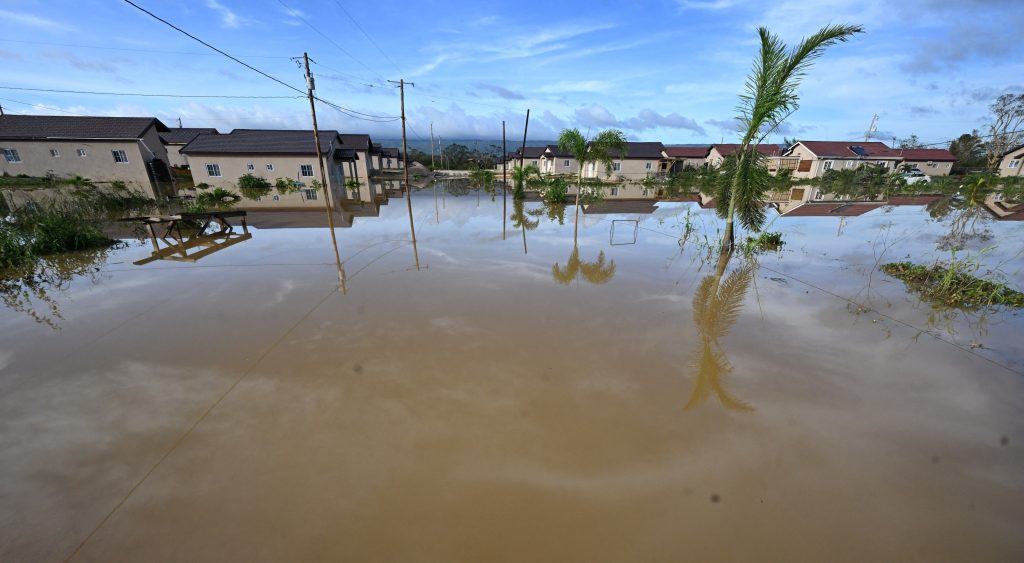
When Hurricane Melissa tore through Jamaica in October, Jordan Senior watched his primary source of income disappear under knee-deep floodwaters.
His rental cabin in Treasure Beach, which typically brings in around $30,000 annually, now sits submerged and unrentable — potentially for months.
Must Read
- Thanks to Jeff Bezos, you can now become a landlord for as little as $100 — and no, you don’t have to deal with tenants or fix freezers. Here’s how
- Robert Kiyosaki says this 1 asset will surge 400% in a year — and he begs investors not to miss its ‘explosion’
- Dave Ramsey warns nearly 50% of Americans are making 1 big Social Security mistake — here’s what it is and 3 simple steps to fix it ASAP
Even worse, construction on multiple other properties Senior was building with $60,000 in savings is significantly set back, including a near-complete villa that lost its roof and suffered major structural damage (1).
Senior’s story isn’t just about one unlucky landlord. It’s a stark reminder of the financial vulnerabilities facing short-term rental investors, particularly those in hurricane-prone coastal areas during peak booking season.
‘Airbnb has canceled my bookings’
Senior’s Cashaw Cabin, a one-bedroom A-frame property with a private pool that he built in 2022 for about $40,000, was thriving before Melissa made landfall.
The property is typically booked for 15 to 20 nights in a month throughout the year, but from mid-November to May, the property is booked nearly every night. The cabin charges between $115 and $150 per night — depending on the season — on platforms such as Airbnb, Booking.com and Expedia.
As Senior shared with Business Insider, the timing couldn’t be worse. Hurricane Melissa struck just before the Caribbean’s lucrative high season, and Senior says he may not be able to open until January, which would wipe out months of his busiest booking period.
"Airbnb has canceled my bookings,” Senior explained. “I understand, that’s no problem, they have to look after people. But at the same time, maybe the host needs some help, too. If you’re canceling bookings months after a storm, that doesn’t really work out for the hosts because we don’t have anything to look forward to in terms of earnings."
And the financial cascade doesn’t stop there. Senior had been using Cashaw Cabin’s earnings to fund his villa project, which was weeks away from launch. Now, he’ll need to dip further into his savings just to repair the damage — money that was earmarked for finishing touches.
Trending: I’m almost 50 and have nothing saved for retirement — what now? Don’t panic. These 6 easy steps can help you turn things around
Climate change amplifies the risks
Climate change can be a costly factor for landlords, and not just in the Caribbean. In 2023 alone, the U.S. saw 28 individual climate disasters, costing over $1 billion each and creating damages of nearly $93 billion, according to BDO (2).
Furthermore, according to New Silver, properties in high-risk areas, like Senior’s cabin, are thought to be overvalued by hundreds of billions of dollars, since valuations sometimes don’t account for long-term costs like disaster recovery or insurability (3).
How to safeguard your rental investment
Smart landlords can take several protective measures to minimize their exposure to catastrophic losses.
1. Get the right insurance coverage
Standard homeowners insurance often won’t cut it for short-term rentals.
Flood insurance through the National Flood Insurance Program caps contents coverage at $100,000 for rental properties (4), and hurricane deductibles in coastal areas often range from 1% to 5% of the property’s insured value, meaning a $200,000 property could have a $10,000 deductible (5).
According to vacation rental insurance specialists, rental property owners need landlord insurance that specifically addresses rental property risks, including (6):
- Loss of rental income coverage: This reimburses you for income lost when your property becomes uninhabitable due to covered events — crucial protection that Senior may not have had when Hurricane Melissa struck
- Flood insurance: Standard property insurance policies don’t cover flood damage. You need separate flood insurance through the National Flood Insurance Program or private insurers, especially for coastal properties (7)
- Hurricane and windstorm coverage: Windstorm insurance on high-risk coastal properties can often be excluded from standard policies and therefore requires additional coverage (8)
2. Research your property’s climate risk profile
Before investing in a rental property, conduct thorough climate risk assessments to identify exposure to extreme weather, flooding and a rise in sea level.
Review both past weather patterns, along with what’s expected in the future, to gauge your potential risk exposure and vulnerability.
3. Understand the surrounding area’s infrastructure
Research flood zones, drainage systems and your rental property’s proximity to bodies of water. Properties in FEMA-designated flood zones face higher insurance costs and greater risk.
4. Build an adequate emergency fund
As he explained to Business Insider, Senior is now forced to drain his savings for repairs — a position no rental landlord wants to be in. You can avoid this by maintaining an emergency fund that can cover at least three-to-six months’s worth of potential rental income, plus a separate fund for major repairs.
5. Diversify your investment locations
It’s prudent not to concentrate all of your rental properties in a single climate-vulnerable region. Geographic variation can help to spread out your risk and balance a stable area with any potential losses from climate events occurring in another area.
What to read next
- Dave Ramsey says this 7-step plan ‘works every single time’ to kill debt, get rich — and ‘anyone’ can do it
- Are you richer than you think? 5 clear signs you’re punching way above the average American’s wealth
- Warren Buffett used 8 simple money rules to turn $9,800 into a stunning $150B — start using them today to get rich (and then stay rich)
- This tiny hot Costco item has skyrocketed 74% in price in under 2 years — but now the retail giant is restricting purchase. Here’s how to buy the coveted asset in bulk
Join 200,000+ readers and get Moneywise’s best stories and exclusive interviews first — clear insights curated and delivered weekly. Subscribe now.
Article sources
We rely only on vetted sources and credible third-party reporting. For details, see our editorial ethics and guidelines.
Business Insider (1); BDO (2); New Silver (3); Congress.gov (4); Insurance Information Institute (5); Hippo Insurance (6); FEMA (7); Deserving Vacations (8)
This article originally appeared on Moneywise.com under the title: Landlord questions AirBnB after hurricane leaves beachfront property uninhabitable
This article provides information only and should not be construed as advice. It is provided without warranty of any kind.