
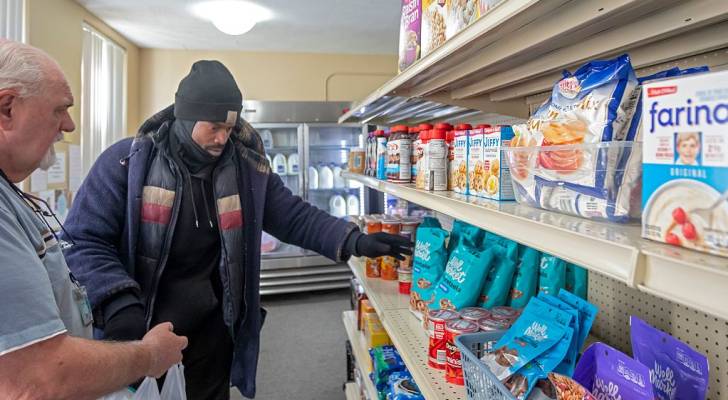
Food banks across the U.S. are struggling to keep up with rising demand even as SNAP payments have resumed following recent funding disruptions.
Greater Boston Food Bank’s warehouse lead, Adrian James, tells NPR, "This is just the beginning. Who knows how bad it could get. That’s the scary part. (1)"
Must Read
- Real Estate: Thanks to Jeff Bezos, you can now become a landlord for as little as $100 — and no, you don’t have to deal with tenants or fix freezers. Here’s how
- Retirement: Dave Ramsey warns nearly 50% of Americans are making 1 big Social Security mistake — here’s what it is and 3 simple steps to fix it ASAP
- Investing: Warren Buffett used 8 solid, repeatable money rules to turn $9,800 into a $150B fortune. Start using them today to get rich (and stay rich)
And there’s no sign of relief in sight. In fact, as PBS reports, there are more cutbacks and restrictions coming (2).
“While food stamp benefits are flowing again for now, the massive Republican tax-and-spending law signed by President Trump this summer contains perhaps the biggest looming cut to food assistance and America’s social safety net in decades,” said journalist William Brangham. “Millions of Americans could soon find themselves without assistance starting very soon.”
The scale of the problem
It’s the combination of disrupted benefits, upcoming long-term SNAP cuts under the Big Beautiful Bill Act and rising operating costs pushing food banks far beyond their typical holiday-season strain, and possibly a new normal.
For one, the Big Beautiful Bill Act signed in July contains $187 billion in SNAP cuts over the next decade, according to the Congressional Budget Office (CBO). Among the changes to impact SNAP benefits will be work requirement expansions affecting adults ages 55-64 and parents with children over 14.
Adding to the pressure is the Trump administration’s freezing of about $500 million in funding for The Emergency Food Assistance Program (TEFAP), which sends USDA-purchased food to food banks. Nonprofit network Feeding America says more than 20% of food distributed through its member food banks and local hunger-relief programs comes from TEFAP.
At the San Antonio Food Bank, CEO Eric Cooper told NPR inventory is at less than half normal levels the week before Thanksgiving and rising costs are making it difficult to restock.
“It’s been a rough 2025,” Cooper said separately to PBS. “We have received a reduction in the amount of food that we have been getting year over year when it comes to federal programs.” Why food banks can’t fill the gap
The problem is that food banks simply cannot absorb the shortfall or scale quickly enough — not just because of billions in SNAP cuts pending, but also the additional safety-net reductions expected in programs like Medicaid and health subsidies. So, the pressure to fill the gap shifts to donors, consumers and local governments.
Read more: Robert Kiyosaki says this 1 asset will surge 400% in a year — and he begs investors not to miss its ‘explosion’
According to Feeding America, for every meal it provides, SNAP provides nine. But, as Laura Lester, CEO of Feeding Alabama, plainly explained to AL.com: "If $230 billion are cut from the SNAP program, there is no backup plan. (3)"
The Food Bank of Alaska echoed this speaking to the Center for American Progress: "Food pantries are already at capacity. When SNAP is slashed, we see it in real time … We can’t fill the gap. No food bank can. (4)"
On top of the increased demand, food banks are simultaneously dealing with rising costs. Operating expenses have climbed as they hire additional drivers, pay overtime to warehouse staff and purchase food at higher prices. Food-at-home prices remain elevated, making it more expensive for food banks to purchase supplies when donations fall short.
What it means for your wallet and community
The situation signals prolonged pressure on low-income households, continued shortages at food pantries and rising charitable demand on middle- and upper-income Americans. For households with discretionary income, the pressure to contribute is intensifying and will continue escalating as federal cuts take effect over the next several years. Specifically:
-
Donation demands will increase. Food banks will increasingly depend on higher-income households for financial contributions and volunteer support. Expect more frequent fundraising campaigns and emergency appeals as the gap between need and federal support widens.
-
Retail ripple effects. Reduced SNAP purchasing power translates to lower sales at grocery retailers, particularly in low-income communities. This could affect performance at major food chains. SNAP benefits generate significant economic activity — according to USDA research, every $1 in government spending on SNAP benefits generates approximately $0.80-$1.50 in economic activity.
-
Budget cuts & tax implications. As food banks lean on state and municipal support to fill federal gaps, communities may face difficult budget choices.
-
States will face new cost-sharing requirements, potentially needing to spend as much as $92 million (Texas) and $111 million (California) annually just to maintain current SNAP coverage, according to Urban Institute analysis and crowd out other services or require tax increases in the process (5).
-
Community economic strain. Persistent food insecurity can increase demand for state and local aid programs beyond food assistance, including emergency healthcare, housing support and utility assistance, creating cascading pressure on municipal budgets.
How to give effectively
With resources stretched thin, strategic giving matters more than ever. Here’s how to maximize impact:
-
Prioritize infrastructure over one-time gifts. Organizations with strong logistics capacity, like Feeding America affiliates, leverage bulk purchasing power and established supply chains, meaning donated dollars go further.
-
Consider unrestricted funding. While it’s tempting to donate specific items, unrestricted cash donations allow food banks to purchase what they actually need, when they need it and often at wholesale prices significantly below retail.
-
Look at operational efficiency. Before donating, review organizations’ financial statements and efficiency ratings.
-
Think beyond holidays. Summer months tend to see the lowest donation volumes, but sustained high demand. Recurring monthly gifts provide predictable funding that helps food banks plan purchasing and staffing.
-
Volunteer strategically. Food banks increasingly need skilled volunteers for warehouse operations, logistics coordination and fundraising — roles that leverage professional expertise rather than just sorting donations.
What to read next
- Approaching retirement with no savings? Don’t panic, you’re not alone. Here are 6 easy ways you can catch up (and fast)
- Dave Ramsey says this 7-step plan ‘works every single time’ to kill debt, get rich — and ‘anyone’ can do it
- Grant Gardone reveals the ‘real problem’ with US real estate (and what average Americans must actually do to get rich)
- 22 US states are already in a recession — protect your retirement savings with these 10 essential money moves ASAP
Join 200,000+ readers and get Moneywise’s best stories and exclusive interviews first — clear insights curated and delivered weekly. Subscribe now.
Article sources
We rely only on vetted sources and credible third-party reporting. For details, see our editorial ethics and guidelines.
NPR (1); PBS (2); AL.com (3); Center for American Progress (4); Urban Institute (5)
This article provides information only and should not be construed as advice. It is provided without warranty of any kind.