
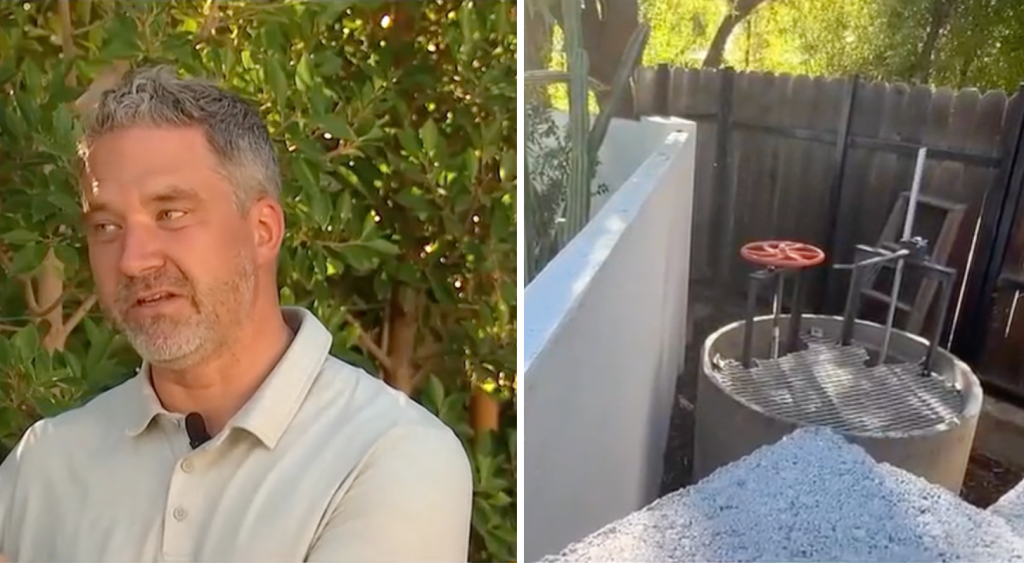
When Pomelo Park homeowner Rob Headley put up a privacy wall along his property line last year he figured he’d done everything by the book. The Phoenix resident filed the permits with the city before breaking ground on the project, which was part of a major overhaul of his house and backyard (1).
Then his neighbors sounded the alarm. The new wall, they said, cuts off access to an irrigation standpipe reachable via Headley’s backyard, which helps keep the area’s lawns green in 110-degree heat.
Must Read
- Thanks to Jeff Bezos, you can now become a landlord for as little as $100 — and no, you don’t have to deal with tenants or fix freezers. Here’s how
- Robert Kiyosaki says this 1 asset will surge 400% in a year — and he begs investors not to miss its ‘explosion’
- Dave Ramsey warns nearly 50% of Americans are making 1 big Social Security mistake — here’s what it is and 3 simple steps to fix it ASAP
Shane Abowitt, a resident of the area for more than four decades, told Arizona media group Arizona’s Family, “If you take out one standpipe, that could be a critical disruption to the whole water district.”
Headley pushed back, saying the standpipe isn’t even on his land: ”There’s no need for folks to walk on our property to get to someone else’s property” (2).
But while the standpipe may not be on his land, the pathway to reach it runs through a Public Utility Easement (PUE) that is on his property. And that easement legally limits what he’s allowed to build there.
Now the city is threatening to revoke his wall permit entirely.
And for Headley, the situation highlights a hard truth most homeowners don’t learn until it’s too late: you can own the land, pull a permit, and still not have the freedom to build what you want.
What is an easement, and why does it trump a permit?
An easement is a legal right that allows someone else (usually a city, utility company or irrigation district) to use part of your property for a specific purpose, even though you still own the land. In Headley’s case, a Public Utility Easement (PUE) gives workers the right to cross his yard to reach shared water infrastructure.
According to Phoenix’s Planning and Development Department, “if your property contains a critical area, such as a[n] easement, restrictions may be placed on where you can build a fence or wall” (3).
Easements are more commonplace than you might realize. “Most real estate is subject to one form of an easement or another,” write Arizona real estate attorney Bryan L. Eastin and licensed Real Estate Instructor and founder and Managing Partner of Provident Law, Christopher J. Charles.
And in Arizona, easements run with the land, meaning they stay in place when the property changes hands, so a new homeowner like Headley is subject to the easement, no matter what his personal take might be.
Here’s the catch: a building permit doesn’t override an easement. Phoenix expects homeowners to identify easements themselves and get written approval from any utility or irrigation district that needs access before building on or near that area.
City officials told Arizona’s Family that the Pomelo Park Irrigation Water Delivery District was never consulted before the wall went up. That’s why the city is now reviewing his permit and considering revoking it (4).
Worse news lurks for Headley amongst the policy literature on Phoenix’s municipal website: walls like his in a “Public Utility Easement (PUE) may be removed by the city or utility provider for installation or repair of utilities. Replacement […] will be at the owner’s expense” (5).
Trending: Approaching retirement with no savings? Don’t panic, you’re not alone. Here are 6 easy ways you can catch up (and fast)
What every homeowner should know: there’s nothing easy about easements.
Easements aren’t inherently bad, but they can surprise homeowners who learn about them only after they’ve built something expensive or after a neighbor complains.
Here’s how to avoid ending up in Headley’s situation.
- Scrutinize the title report. When you’re in the process of closing on your new house, make a point of taking a magnifying glass to the Title Report “for all liens and encumbrances, including easements,” and ensure that you know what that means (6).
- Check before you dig, even if you have a permit. If you know your property includes an easement, double check your property records to verify your access rights, and determine your responsibilities to the government and utility companies.
- Assume anything built on an easement is temporary. In Phoenix, and many other jurisdictions, if you build a wall, fence, or even plant shrubs on an easement for public utilities, this could be taken down by the city or a utility so as to get to their equipment.
- Document disputes early. If it comes to that, ensure you have backed up every part of your process.
In Arizona, regular long-term use of part of your property by others can eventually “ripen” into a legal easement. If this is happening to you, seek legal advice before this use “ripens” into an easement.
Headley’s situation is a warning to homeowners everywhere: knowing what’s under your land is important, but knowing what’s allowed on your land matters just as much. Before you build a wall, plant a hedge, or expand your yard, make sure you’re not building on someone else’s rights, even if the paperwork says the land is yours.
What to read next
- Grant Cardone argues this is ‘the real problem’ why Americans can’t scale their wealth with real estate. Here are 5 ways to invest like the big players
- Warren Buffett used 8 solid, repeatable money rules to turn $9,800 into a $150B fortune. Start using them today to get rich (and stay rich)
- Dave Ramsey says this 7-step plan ‘works every single time’ to kill debt, get rich — and ‘anyone’ can do it
- 22 US states are already in a recession — protect your savings with these 10 essential money moves ASAP
Join 200,000+ readers and get Moneywise’s best stories and exclusive interviews first — clear insights curated and delivered weekly. Subscribe now.
Article sources
We rely only on vetted sources and credible third-party reporting. For details, see our editorial ethics and guidelines.
Arizona’s Family (3TV / CBS 5) (1, 2, 4); Phoenix.gov (3, 5); Arizona School of Real Estate Business (6)
This article provides information only and should not be construed as advice. It is provided without warranty of any kind.