
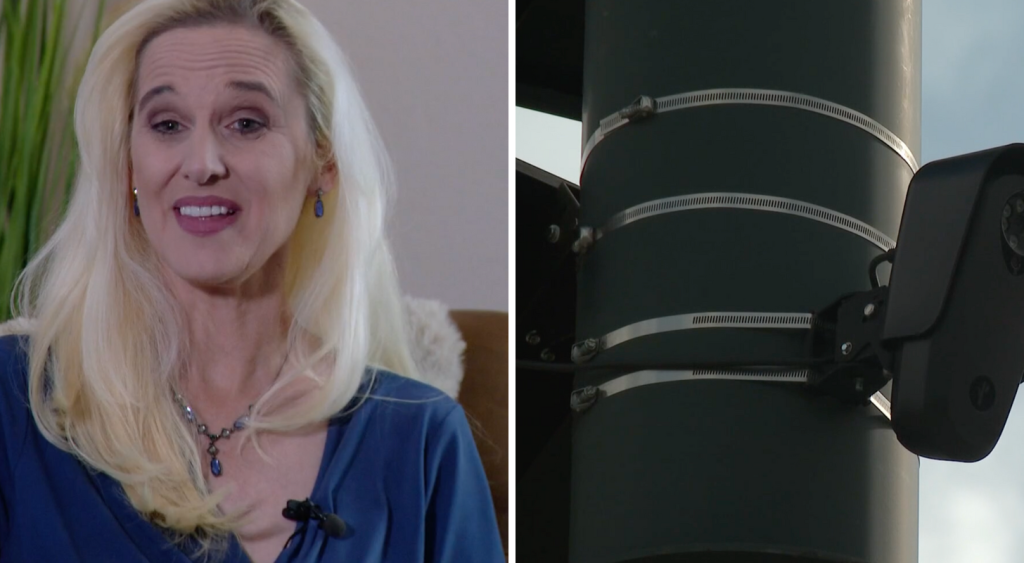
They say that the camera never lies but, in the case of one Colorado woman, it certainly didn’t get to the truth of the matter either.
Chrisanna Elser discovered that the hard way when a police officer showed up on her Denver doorstep on September 27 claiming that video footage from local Flock cameras — an AI-powered automated license plate reader (ALPR) system mounted at intersections, on telephone poles and elsewhere in the community — implicated her in the theft of a package from the victim’s front porch in the nearby town of Bow Mar five days earlier.
Must Read
- Thanks to Jeff Bezos, you can now become a landlord for as little as $100 — and no, you don’t have to deal with tenants or fix freezers. Here’s how
- Dave Ramsey warns nearly 50% of Americans are making 1 big Social Security mistake — here’s what it is and 3 simple steps to fix it ASAP
- Robert Kiyosaki says this 1 asset will surge 400% in a year — and he begs investors not to miss its ‘explosion’
The officer, Sgt. Jamie Milliman of the Columbine Valley Police Department, wouldn’t let Elser see the footage of her Rivian truck driving through Bow Mar around the time of the theft, or the victim’s doorbell cam video allegedly showing Elser stealing the package, according to The Colorado Sun (1). He also didn’t want to view Elser’s own footage, shot from a camera mounted on her truck, that showed exactly where she had travelled during the time of the theft. Instead the officer, whose interaction with the woman was caught on Elser’s doorbell cam, told her that the case “is a lock. One hundred percent. No doubt.”
Except there was doubt — because Elser was innocent. Yes, she had travelled to Bow Mar around the time of the theft, but only to visit her tailor. But after Milliman delivered a summons to appear in court, Elsner knew she had to find a way to prove she was innocent.
“I didn’t do a lot of sleeping the first couple of nights,” she told the Sun, noting she and her husband got to work on compiling evidence. “We had to basically exonerate ourselves.”
And despite the police obtaining videos that supposedly implicated Elser, she did manage to prove her innocence while also serving as a cautionary tale for others who may find themselves in the same nightmarish situation.
Proving the cameras got it wrong
Elser told local NBC affiliate 9 News that, when it came to the charge against her, her “biggest worry” was the advice she received to show up to her court date in two months “and see what happens (2).” She added that she works for a financial institution, and “they don’t exactly enjoy the word theft.”
Sufficiently motivated to beat the charge, Elser and her husband collected evidence of where she was at the date and time of the theft, including, as the Sun noted, videos from her truck and from the tailor’s surveillance camera to prove her whereabouts, as well as photos of the clothes she wore that day and data from her phone that tracked her route.
After repeated calls to the authorities about her case went unanswered, Elser says she mailed her evidence to the police chief. She never received an apology, but she did get a response that said the summons had been voided, along with a pat on the back for all of her legwork.
“People should care because this could be you,” former public defender Ashley White told 9 News. “This is something that police agencies are now using to document and watch what you’re doing, where you’re going, without your consent.”
Read more: I’m almost 50 and have nothing saved for retirement — what now? Don’t panic. These 6 easy steps can help you turn things around
White’s warning comes as use of Flock cameras among law enforcement agencies falls under greater scrutiny. Flock’s own website notes that their surveillance technology is used by “5,000 law enforcement agencies and more than 6,000 communities” across the United States (3). It also touted its $7.5 billion valuation in March, along with a list of crimes — from human trafficking in Detroit to a jewelry heist in Denver — that it claims it helped police thwart (4).
But various civil liberties groups across the U.S. say that Flock’s database of driver info, which can be accessed by police in municipalities across the country that have signed up to the service, is a major breach of personal security.
USA Today wrote that Flock’s location data “can reveal deeply personal details such as where you worship, whom you protest with, or whether you visit a reproductive-health clinic” — pointing to one case in Texas where a sheriff used Flock “to search cameras across state lines in a missing person case involving a woman who had self-administered an abortion (5).”
The ACLU’s Colorado chapter, meanwhile, reported that Flock data obtained in Denver “was searched more than 1,400 times for ICE since June 2024 (6).” That’s compounded with law enforcement’s alleged “3,000 searches related to immigration enforcement on Virginia’s Flock Safety network over a recent 12-month period,” according to the Virginia Center for Investigative Journalism (7), and the University of Washington Center for Human Rights’ claim that the state’s local ALPR data “is being frequently accessed by federal agencies involved in immigration enforcement (8).”
Flock itself admitted in August that they engaged “in limited pilots with the U.S. Customs and Border Protection (CBP) and Homeland Security Investigations (HSI), to assist those agencies in combatting human trafficking and fentanyl distribution (9).” They added that, as of August, “all ongoing federal pilots have been paused” and said in a separate note that local law enforcement sharing data from its network with federal officials “is a local decision … not Flock’s decision (10).”
Still, the non-profit Electronic Frontier Foundation wrote that “ALPR systems are far from being neutral tools for public safety and are increasingly being used to fuel discriminatory policing practices against historically marginalized people (11).”
And concerns about the possible misuse of ALPR data by law enforcement agencies has led to some American cities cutting ties with Flock, while U.S. Senator Ron Wyden wrote to the company’s CEO in October that “Abuse of Flock cameras is inevitable, and Flock has made it clear it takes no responsibility to prevent or detect that. For that reason, I must now recommend that communities that have installed Flock cameras reevaluate that decision (12).”
What to do if you’re falsely accused
Legal experts say that, if you find yourself in a situation where you’re accused of a crime you didn’t commit, there are steps you can take, as Elser did, to help prove your innocence.
To start, many advise hiring a lawyer familiar with false accusation cases immediately and to speak to law enforcement through them.
South Carolina-based Shealey Defense and Injury Attorneys say to “Gather evidence that may exonerate you, such as messages, phone location data, and documents” much like Elser did, while also identifying any witnesses who can speak on your behalf (13).
Palmer Litigation adds that collecting screenshots of social media posts related to the accusation, as well as “keeping meticulous records” of all related “interactions and communications,” could also aid in your defense (14).
Any sort of GPS data, security footage or your own personal video — like Elser’s truck-mounted camera footage — could also provide solid evidence of your whereabouts at the time of the alleged crime, your clothing or other details that could ultimately help clear your name.
What to read next
- Are you richer than you think? 5 clear signs you’re punching way above the average American’s wealth
- Dave Ramsey says this 7-step plan ‘works every single time’ to kill debt, get rich — and ‘anyone’ can do it
- This tiny hot Costco item has skyrocketed 74% in price in under 2 years — but now the retail giant is restricting purchase. Here’s how to buy the coveted asset in bulk
- 22 US states are now in a recession or close to it — protect your savings with these 5 essential money moves ASAP
Join 200,000+ readers and get Moneywise’s best stories and exclusive interviews first — clear insights curated and delivered weekly. Subscribe now.
Article sources
We rely only on vetted sources and credible third-party reporting. For details, see our editorial ethics and guidelines.
Colorado Sun (1); 9News (2); Flock Safety (3, 4, 9, 10); USA Today (5); ACLU Colorado (6); Virginia Center for Investigative Journalism (7); University of Washington Center for Human Rights (8); Electronic Frontier Foundation (11); Ron Wyden (12); Shealey Defense and Injury Attorneys (13); Palmer Litigation (14)
This article originally appeared on Moneywise.com under the title: Police used ‘Flock’ cameras to implicate this Denver woman in a theft — then she had to ‘prove’ her own innocence
This article provides information only and should not be construed as advice. It is provided without warranty of any kind.