
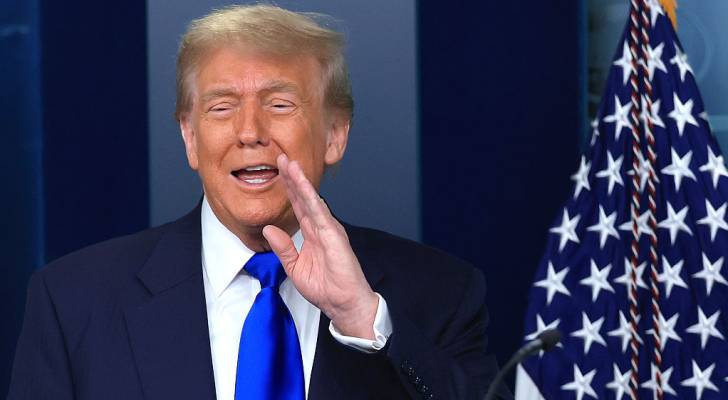
If your bank ever decided to close your account because it didn’t like your political views, it may soon have to pay for it. President Donald Trump has signed an executive order that would penalize financial institutions for “de-banking” customers over their political beliefs.
The order targets banks accused of cutting ties with individuals, businesses or nonprofits due to their political affiliations or ideological stances. And while this may sound like a niche political fight, it could have significant implications for how banks choose their clients, and whether your account could be at risk in the future.
Trump has long claimed that U.S. banks discriminate against conservatives. In recent months, he’s accused lenders of refusing to work with him and his allies, saying they’ve been punished for their political leanings.
Must Read
- Thanks to Jeff Bezos, you can now become a landlord for as little as $100 — and no, you don’t have to deal with tenants or fix freezers. Here’s how
- I’m 49 years old and have nothing saved for retirement — what should I do? Don’t panic. Here are 6 of the easiest ways you can catch up (and fast)
- Dave Ramsey warns nearly 50% of Americans are making 1 big Social Security mistake — here’s what it is and 3 simple steps to fix it ASAP
The politics behind ‘political de-banking’
The push goes beyond Trump himself.
Congressional Republicans and GOP-led states have argued that banks and payment processors are increasingly shunning industries they deem controversial – like gun manufacturers, fossil fuel companies and conservative advocacy groups – under the banner of “reputational risk.” In 2023, 19 state attorneys general accused JPMorgan Chase of discrimination, including the closing of accounts tied to a conservative religious nonprofit.
Trump put big banks on notice during a January 2025 speech at the World Economic Forum in Davos, Switzerland. "I hope you start opening your bank to conservatives, because many conservatives complain that the banks are not allowing them to do business within the bank, and that included a place called Bank of America," Trump said before directly addressing JPMorgan CEO Jamie Dimon: "You and Jamie and everybody, I hope you’re gonna open your bank to conservatives."
What the banks say
Major banks have largely pushed back on the idea that they’re targeting clients for political reasons. After Trump’s Davos address, JPMorgan insisted it doesn’t discriminate based on political or religious views and has updated its public stance to affirm that it serves customers “regardless of political, social or religious viewpoints.”
When banks cut ties with certain industries or clients, it tends to be about managing risk, both financial and reputational.
Reputational risk is a catch-all term for potential harm to a company’s public image that could impact profits. A bank may decide not to finance a coal plant or weapons manufacturer, for instance, if it believes public backlash could hurt shareholder value or trigger customer defections.
Traditionally, reputational risk was seen as part of responsible corporate governance, alongside environmental, social and governance (ESG) criteria. But under the Trump administration, the corporate concept has become a political flashpoint.
Read more: US car insurance costs have surged 50% from 2020 to 2024 — this simple 2-minute check could put hundreds back in your pocket
When banks can refuse service now
Even without politics in the mix, banks are allowed, and sometimes required, to deny service under certain conditions.
Federal law bars them from discriminating on the basis of race, religion, national origin, sex or other protected categories. But it also requires them to comply with anti-money laundering and counterterrorism laws, meaning they can reject customers who pose legal or regulatory risks. Banks can also close accounts for reasons such as fraud suspicion, unpaid fees or simply if the customer’s activities fall outside the bank’s risk tolerance.
How Trump’s order could change the rules
Trump’s order would create financial penalties for banks that close accounts based on political or ideological factors. That could force institutions to justify closures with purely financial or legal reasoning, rather than subjective assessments of reputational harm. The order also seeks a regulatory review of whether banks have had “any past or current, formal or informal” policies leading to “politicized or unlawful debanking.”
It’s not yet clear how political reasons would be defined or enforced. Would it cover a bank refusing to work with a pro-gun group after a mass shooting? What about cutting ties with an oil company after a high-profile environmental disaster? The details will matter, and they could trigger years of legal challenges.
For customers, the order might provide an extra layer of protection against being dropped for ideological reasons. But it could also make banks more cautious about taking on potentially risky clients, knowing they could be accused of political bias and fined. That caution could slow new account approvals for certain nonprofits, advocacy groups or politically active businesses.
Why this matters to you
Most Americans will never face “political de-banking.” But if you run a business, donate to controversial causes or work in a politically charged industry, it’s conceivable that Trump’s order could change how banks treat you.
On one hand, it could protect your right to maintain a bank account without fear of ideological discrimination. On the other, it could make banks less willing to partner with organizations they fear could attract political controversy – potentially limiting choice and raising costs.
What to read next
- How much cash do you plan to keep on hand after you retire? Here are 3 of the biggest reasons you’ll need a substantial stash of savings in retirement
- There’s still a 35% chance of a recession hitting the American economy this year — protect your retirement savings with these 5 essential money moves ASAP
- This tiny hot Costco item has skyrocketed 74% in price in under 2 years — but now the retail giant is restricting purchase. Here’s how to buy the coveted asset in bulk
- Want an extra $1,300,000 when you retire? Dave Ramsey says this 7-step plan ‘works every single time’ to kill debt, get rich in America — and that ‘anyone’ can do it
Join 200,000+ readers and get Moneywise’s best stories and exclusive interviews first — clear insights curated and delivered weekly. Subscribe now.
This article provides information only and should not be construed as advice. It is provided without warranty of any kind.