
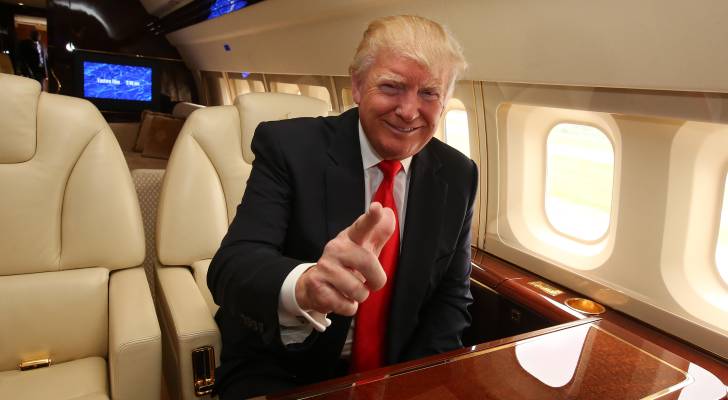
For wealthy Americans, business is taking off — literally.
That’s thanks to a revived tax break from the first Trump administration, called bonus depreciation.
Must Read
- Thanks to Jeff Bezos, you can now become a landlord for as little as $100 — and no, you don’t have to deal with tenants or fix freezers. Here’s how
- Robert Kiyosaki says this 1 asset will surge 400% in a year — and he begs investors not to miss its ‘explosion’
- Dave Ramsey warns nearly 50% of Americans are making 1 big Social Security mistake — here’s what it is and 3 simple steps to fix it ASAP
Bonus depreciation lets businesses write off 100% of big-ticket business purchases like new tech, equipment, or upgrades in the year they are purchased. By front-loading those tax breaks, the policy gives companies a reason to spend now — nominally fueling investment, productivity, higher pay, and new jobs down the line, according to the Tax Foundation (1).
It also means that private jet brokers, car wash developers, and luxury accountants say they’ve never been busier.
According to jet broker Global Charter, private jet industry sales are up 11% from last year and 30% higher than the year before. CEO Dan Hurley says his phone hasn’t stopped ringing.
“They weren’t even going to use the jet,” he told Bloomberg about one client. “They’re just going to charter it out to the wider market and offset a load of tax by acquiring it” (2).
But while this isn’t a tax break for your average American, could the knock-on effects impact everyday consumers?
The tax break fueling the frenzy
Bonus depreciation isn’t new. Trump’s 2017 tax overhaul temporarily allowed the write-off, too, but the perk started phasing out after 2022. Now, under the One Big Beautiful Bill Act, the full 100% deduction is back, and this time, it’s permanent (3).
On paper, the goal is to encourage business investment. But in practice, some tax strategists say it’s also become a loophole gold mine for the ultra-wealthy.
At Engineered Tax Services, a Florida-based advisory firm, real estate projects under review are up a whopping 145% from last year. Chief Marketing Officer Heidi Henderson told Bloomberg, “We are seeing a huge uptick,” adding, “We are getting so many calls from people asking, ‘What should we buy, how can we take the most advantage?’”.
So who exactly is cashing in? It’s business owners, real estate investors, and family offices with serious cash flow.
Mark Johnson, a Colorado entrepreneur, first used the break in 2017 when he was looking to sell his family business. Instead of cutting a massive check to the IRS, his accountants advised him to buy several car washes. “It works while I’m alive and, at my death, the estate’s going to have to pay tax, but my heirs will have a pretty nice bunch of assets,” he said. “Then the whole thing starts over again.”
Why private jets, car washes and gas stations?
They’re top picks because they’re packed with depreciable equipment. Glen Kunofsky, CEO of commercial real estate firm Surmount, says his company has sold $5 to $6 billion worth of car washes since 2017, with projects ramping up again fast (2).
The Joint Committee on Taxation is estimating that this loophole will cost $363 billion in lost IRS revenue over ten years (4).
Some critics, like Steve Wamhoff of the Institute on Taxation and Economic Policy, say this policy is fueling investment in all the wrong places.
Wamhoff slammed the policy for being inefficient, saying it nudges investors to pour money into assets they don’t actually need just to score a tax break. “As a result, some people are more likely to build a car wash than build something that is really needed, like housing,” he said (2).
But for the top 1%, the savings are too good to ignore.
After the 2017 bonus depreciation boost, gas stations and car washes became hot commodities, data from CoStar Group shows (5).
“A significant increase would be putting it mildly,” said Brandon Svec, CoStar’s national director of retail analytics. He noted that gas station sales surged beyond the rest of the retail market, and car wash deals climbed right alongside them.
“We talk to business owners all the time,” Tom Bratkovich, CIO at DCA Family Office, told Bloomberg, saying the frenzy over these assets has made it nearly impossible to snag a good deal for his clients (2).
Trending: I’m almost 50 and have nothing saved for retirement — what now? Don’t panic. These 6 easy steps can help you turn things around
Does bonus depreciation impact you?
Even if you have the money to burn, you might want to think twice about buying a jet to show off on Instagram and calling it a “business expense,” unless you want the IRS knocking on your door (6).
Duncan Campbell of advisory firm Baker Tilly told Bloomberg that airplane deductions are often examined more closely, so assets must be used for business purposes (2).
And even though a private jet can qualify as a business expense, it’s supposed to be part of a profitable operation, which isn’t always the case; ProPublica’s review of tax records from over 30 wealthy jet owners found that turning a profit from chartering these planes was virtually unheard of (7).
With jet demand soaring, the travel market could see some ripple effects, but likely only for the ultra-wealthy. According to Business Jet Traveller, charter companies are already facing a capacity strain for aircraft, which could mean higher prices for those who rent (8). But because private jets operate in a different market from commercial airlines, these changes are unlikely to touch the average American, whose fares are set by capacity, market demand, and fuel costs, to name a few (9).
Whether you’re thinking of a private jet, a car wash, or another way to leverage the bonus depreciation tax break, if you’re a business owner and considering it, this is what the IRS needs you to know.
- It must be a business asset. Planes, equipment, and certain property qualify, but personal purchases don’t.
- It must be in use by Dec. 31. You can’t just order it; it has to be operational this year.
- Keep records of business use and document everything.
- Get expert help from a professional who can guide you accurately.
- Claim it properly and file with IRS Form 4562 when you do your taxes (10).
Trump’s bill has made it possible for anyone with millions to attempt to spend their way out of a massive tax bill. As for the average American taxpayer, the next time you see a new car wash pop up on your block or another jet idling at the runway, it could be a new booming business — or a tax plan with wings.
What to read next
- Dave Ramsey says this 7-step plan ‘works every single time’ to kill debt, get rich — and ‘anyone’ can do it
- Are you richer than you think? 5 clear signs you’re punching way above the average American’s wealth
- Warren Buffett used 8 simple money rules to turn $9,800 into a stunning $150B — start using them today to get rich (and then stay rich)
- This tiny hot Costco item has skyrocketed 74% in price in under 2 years — but now the retail giant is restricting purchase. Here’s how to buy the coveted asset in bulk
Join 200,000+ readers and get Moneywise’s best stories and exclusive interviews first — clear insights curated and delivered weekly. Subscribe now.
Article Sources
We rely only on vetted sources and credible third-party reporting. For details, see our editorial ethics and guidelines.
Tax Foundation (1); Bloomberg (2);
H.R.1 – One Big Beautiful Bill Act (3); Tax Policy Center (4); CoStar Group (5); The Associated Press (6); ProPublica (7); Business Jet Traveller (8); McKinsey (9); IRS (10)
This article provides information only and should not be construed as advice. It is provided without warranty of any kind.