
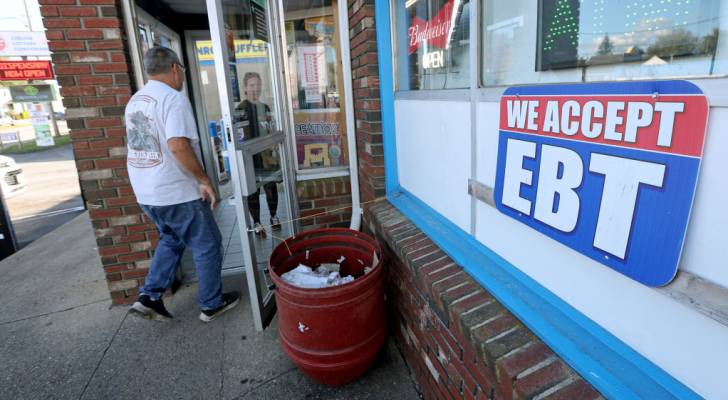
Given all the discussion about the federal supplemental nutrition assistance program (SNAP) benefits that took place while they were threatened and delayed during the recent government shutdown, you’ve probably heard a lot about supposedly fraudulent uses of the program.
In fact, although errors happen on occasion, intentional fraud on the part of SNAP recipients is rare (1). There’s not a problem of too many people “taking advantage” of benefits, but rather, too few: According to the U.S. Census, about one in six people who qualify for SNAP do not participate in the program (2).
Must Read
- Thanks to Jeff Bezos, you can now become a landlord for as little as $100 — and no, you don’t have to deal with tenants or fix freezers. Here’s how
- Robert Kiyosaki says this 1 asset will surge 400% in a year — and he begs investors not to miss its ‘explosion’
- Dave Ramsey warns nearly 50% of Americans are making 1 big Social Security mistake — here’s what it is and 3 simple steps to fix it ASAP
But what is common — and underappreciated — is for SNAP recipients to be stolen from. And it has to do with the outdated technology used to deliver benefits, called EBT (electronics benefit transfer).
The true scale of the theft of food assistance benefits from needy families in America may be impossible to know. While states officially reported $136 million in stolen SNAP benefits for the first quarter of 2025, federal investigators suspect it could be higher — much higher.
Mark Haskins, branch chief of the USDA Food and Nutrition Service’s special investigations unit, made clear that nobody knows the true scope. Haskins told InvestigateTV that USDA Secretary Brooke Rollins isn’t taking reported statistics as "gospel," adding, "It could be as high as $12 billion a year” (3).
Behind nearly all of this fraud lies a single, devastatingly simple technique: card skimming. Criminals install illegal devices on payment terminals that capture electronic EBT card information and PINs when recipients swipe their cards for groceries.
How skimming is fueling the fraud epidemic
Skimmers work by recording card data when magnetic stripes are swiped — currently the only SNAP redemption method in most states.
The technology gap is a big one. While credit and debit cards moved to chip technology decades ago, SNAP continues relying on older magnetic stripe card technology. Once criminals have card data, they create clones and drain accounts within hours (4).
"What I don’t understand, though, is how in the world when the entire world switched to chip-enabled cards over a decade ago, why the food stamp program didn’t do the same thing," Haywood Talcove, CEO of government business for LexisNexis Risk Solutions, told CBS News (5).
And the sophistication continues evolving. Haskins noted that criminals employ brute force attacks — software that can guess a four-digit PIN in just one second, since all EBT cards in each state start with the same numbers.
“They’re taking it to the next level every day,” he said (3).
Investigators executing the USDA’s National Farm Security Action Plan have been manually canvassing stores and gas stations, resulting in dozens of confiscated skimming devices.
But this labor-intensive approach is reactive in nature. While many criminals are part of international organized crime groups, according to the Secret Service, the government’s failure to modernize card technology has created the opportunity for theft.
Why taxpayers should care
Each month, over 41 million Americans depend on SNAP to afford food, and since early 2023, over 670,000 households have had benefits stolen, according to Nextgov (4).
When those benefits go unreplaced — federal reimbursements ended in December 2024 — families skip meals and turn to food banks. And if they receive a refund through state funds, it’s taxpayers who foot the bill, as states must find funding in their own budgets (6).
The $12 billion in potential annual losses represents taxpayer money diverted from feeding vulnerable Americans to funding criminal enterprises. Georgia reported a particular escalation: the state reported just $4.4 million stolen in all of 2024, but nearly $23 million disappeared in the first quarter of 2025 alone (3).
Trending: Approaching retirement with no savings? Don’t panic, you’re not alone. Here are 6 easy ways you can catch up (and fast)
Additionally, research from the Mercatus Center at George Mason University argues SNAP’s overall overpayment rate climbed from just over 2% in 2012 to over 10% in 2023, largely but not entirely due to reduced surveillance and looser enforcement of eligibility criteria during the Covid-19 pandemic. The total of all SNAP overpayments was about $10 billion in 2023 according to the research — and that’s without considering the impact of card skimming (7).
These combined costs add to government expenditures that all taxpayers ultimately fund through federal and state budgets. So, regardless of whether you’re receiving SNAP benefits, your income could ultimately be impacted if the crime persists.
How to protect yourself
For SNAP recipients, protection requires vigilance. Do these things to protect yourself and your family (3):
- Lock your card between uses. Download the ConnectEBT app and enable "lock my card everywhere" to block all transactions when not shopping.
- Inspect terminals carefully. Before swiping, check if the card reader appears different from others or is loose, crooked or damaged. If the keypad feels thick or numbers are hard to press, don’t use it.
- Cover your PIN. Always shield the keypad when entering your PIN. If you live in one of the two states that are introducing chip cards, tap your card rather than inserting or swiping it.
- Monitor daily. Check your balance and transactions through the ConnectEBT app. Report suspicious activity immediately.
- Avoid high-risk locations. At gas stations, pay inside rather than at the pump. Consider using cash or mobile wallet at unfamiliar stores.
- Change your PIN monthly. Update it just before benefits are deposited to minimize vulnerability windows.
What to read next
- Grant Gardone reveals the ‘real problem’ with US real estate (and what average Americans must actually do to get rich)
- Warren Buffett used 8 solid, repeatable money rules to turn $9,800 into a $150B fortune. Start using them today to get rich (and stay rich)
- Dave Ramsey says this 7-step plan ‘works every single time’ to kill debt, get rich — and ‘anyone’ can do it
- 22 US states are already in a recession — protect your savings with these 10 essential money moves ASAP
Join 200,000+ readers and get Moneywise’s best stories and exclusive interviews first — clear insights curated and delivered weekly. Subscribe now.
Article Sources
We rely only on vetted sources and credible third-party reporting. For details, see our editorial ethics and guidelines.
U.S. Congress (1); U.S. Census (2); InvestigateTV (3); Nextgov (4); CBS News (5); Nextgov (6); Mercatus (7)
This article provides information only and should not be construed as advice. It is provided without warranty of any kind.