

WSW, NY, August 25th, 2026, NewsDirect
An overlooked corner of wound care may be its largest. New research sizes the U.S. market for enzyme-based debridement at roughly $4 billion by 2028, and MediWound is positioning EscharEx against a treatment that has gone unchallenged for six decades.
More than 2.5 million Americans develop pressure ulcers every year, the painful wounds and skin injuries that develop when patients are bedridden or immobilized for long periods. Most people know them as bedsores. They contribute to approximately 60,000 deaths annually and cost the healthcare system between $9.1 billion and $11.6 billion per year, according to the Agency for Healthcare Research and Quality. A single severe case can cost up to $151,700. And the problem is getting worse: globally, the absolute number of pressure ulcer cases has more than doubled since 1990, according to data from the Global Burden of Disease Study, even as age-adjusted rates have declined, a gap driven largely by aging demographics. MediWound (Nasdaq: MDWD) may have a solution, and new research is putting a number on the opportunity.
Sizing an Overlooked Market
Despite those numbers, pressure ulcers rarely come up in the biotech wound-care conversation. There is a lot of focus that goes to diabetic foot ulcers and venous leg ulcers. But new market research presented by MediWound suggests pressure ulcers may be the largest patient population of the three, and an overlooked commercial opportunity.
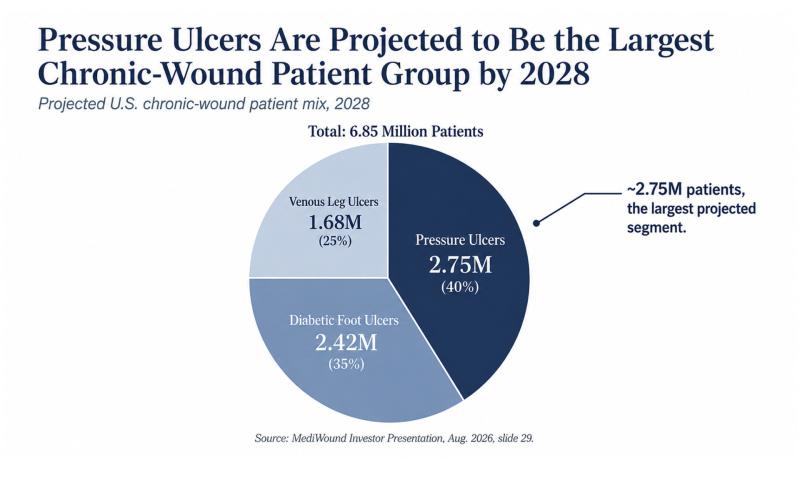
An estimated 6.85 million Americans are projected to be living with chronic wounds by 2028, with roughly 4 million requiring debridement, the medical process of removing dead tissue so new skin can grow. Of the almost 7 million chronic wound patients, pressure ulcer patients are projected to be the single largest group at approximately 2.75 million. The modeled U.S. addressable market for enzyme-based wound treatment across all three types is estimated at approximately $4 billion by 2028, with pressure ulcers alone representing roughly $1 billion. MediWound estimates annual peak U.S. sales potential for EscharEx at approximately $1.05 billion following expansion of the market assessment to include pressure ulcers.
Disrupting the Treatment Landscape
When a chronic wound contains dead tissue, removing it is often an important step before healing can begin. For six decades, one product has dominated that process in the U.S.: Santyl, an enzyme-based drug first approved in 1965 with annual sales exceeding $400 million, according to MediWound. In a market built around a single product that has been used for decades, the opening for a faster alternative is clear.
MediWound’s investigational biologic drug , EscharEx, uses a targeted enzyme therapy that dissolves dead tissue while leaving healthy skin intact. In the primary analysis of a Phase 2 clinical trial in venous leg ulcers, EscharEx achieved complete debridement in a median of approximately nine days. In a comparative analysis within that same trial, a subgroup of eight patients treated with Santyl achieved zero percent complete removal of dead tissue at two weeks, compared with 63 percent for the 46 patients treated with EscharEx (p=0.001). EscharEx is not approved for any indication and remains in clinical development, with a Phase 3 trial currently underway in venous leg ulcers. The global Phase 3 VALUE trial is targeting 216 patients across approximately 40 sites in the U.S., Europe and Israel, with an interim sample-size reassessment and enrollment completion expected by the end of the first quarter of 2027. Meanwhile, an investigator-initiated trial on pressure ulcers is starting towards the end of 2026.
There is clinical momentum behind the approach. A multidisciplinary panel of U.S. wound care experts, publishing in the journal WOUNDS, recently recommended that debridement should begin early in treatment and that clinicians should consider effective, less invasive approaches when appropriate. MediWound highlighted the publication in an April 2026 press release, noting that this recommendation aligns with what EscharEx is designed to do: faster, non-surgical debridement.
Where the Incentives Point
MediWound’s new market research also suggests EscharEx could reshape how wounds are treated across care settings. According to the analysis, EscharEx could expand the share of debridement procedures using enzymatic approaches from approximately 19 percent to 31 percent, drawing volume from surgical, mechanical, and other methods. Much of the pressure ulcer population resides in skilled nursing facilities and long-term care, settings where sharp or surgical debridement is less commonly used. In these facilities, deficiencies in pressure-ulcer prevention or treatment can contribute to enforcement actions, including civil monetary penalties, while pressure-ulcer outcomes are also incorporated into CMS quality ratings. In hospitals, the financial incentives to improve pressure-ulcer care are also significant. Since 2008, Medicare has limited additional hospital payment when Stage III or IV pressure ulcers develop during an inpatient stay and were not present on admission. Together, those policies give providers an economic as well as clinical incentive to prevent worsening wounds and improve treatment efficiency.
If EscharEx ultimately demonstrates efficacy in pressure ulcers and is approved for that use, those incentives could support adoption across these settings. There is no guarantee that ongoing or planned clinical trials will succeed, and the pressure ulcer opportunity still depends on a study that has not yet begun. But in a market that has had one dominant product for sixty years, with a growing patient population and billions in unmet treatment costs, the setup is hard to ignore. For investors watching the wound care space, the market research suggests the addressable opportunity could be substantial.
Recent News Highlights From MediWound (MDWD)
Newly Published U.S. Expert Consensus Aligns with MediWound’s Strategy for Chronic Wound Debridement
MediWound Reports BARDA Contract Award to Vericel for NexoBrid Valued at up to $197 Million
MediWound Successfully Completes Commissioning of Expanded GMP Manufacturing Facility for NexoBrid
MediWound Expands Global Reach with Marketing Approval of NexoBrid in Australia
Important Disclaimers and Disclosures: The author, Wall Street Wire, is a content and media technology platform that connects the market with under-the-radar companies. The platform operates a network of industry-focused media channels spanning finance, biopharma, cyber, AI, and additional sectors, delivering insights on both broader market developments and emerging or overlooked companies. Wall Street Wire is not a broker-dealer or investment adviser. References to market size estimates, valuations, price targets, or other third-party data are provided strictly for informational purposes. Wall Street Wire receives cash compensation from MediWound Ltd. (the “Issuer”) for coverage and awareness services, which are provided on an ongoing subscription basis. The content above is a form of paid advertising and promotion and is for informational purposes only and does not constitute financial or investment advice. This article may contain forward-looking statements about the Issuer’s products, plans, or prospects that are subject to risks and uncertainties; actual results may differ materially, and readers should review the Issuer’s public filings on SEC EDGAR (sec.gov/edgar) for full risk factors. Market size figures, research estimates, or other third-party data referenced in this article are quoted from publicly available sources believed to be reliable; however, we do not independently verify or endorse them, and additional figures or estimates may exist. Full compensation details, information about the operator of Wall Street Wire, and the complete set of disclaimers and disclosures applicable to this content are available at: wallstwire.ai/disclosures. This article should not be considered an official communication of the Issuer.
Contact
Wall Street Wire
[email protected]